As many as tell the tale

As many as tell the tale

The Indian right does it again. They dropped A K Ramanujan's essay in their quest for a perfect world with one sangha line way of looking at it.  So I thought I'd link to it. And revive this tale that's apropos.

Repost


As many as tell the tale

There was always the attention, the eyes that turned towards us throughout the entire journey and the steady stream of questions. We had tired of telling our stories, spending so much of our life like small change on insistent little children who came running up to us, asking, unbridled yet by convention. Our story was now becoming mere words. Every time I told it, reality seemed to erode a bit. It became my construction and not something that had really happened. It was to end soon; it was our last bus ride home.

I sat facing the window; my body sunk into his shoulder, with his arm around me. As I hunkered down for the long dusty ride, I realized that I had wondered whether we would even make it this far, but we had. He had gamely borne the sun, the scrutiny and enjoyed himself nonetheless. As the bus pulled out of the station and into the stone cobbled lanes of an ancient kingdom I said, "Tell me a story." He nuzzled my hair and asked, "What kind?" "Old stories, tell me really old stories, they seem appropriate somehow. Tell me what the world is made of, tell me how it was made."

It never took him long to come up with stories. We had lived worlds apart and our stories were different, we could rely on our old familiars being new to the other. "You remember that beautiful tree in the courtyard?" "Umm hmm, the Frangipani tree." "It made me think of the Yggdrassil." "What is that?", I asked. He mocked something I'd said oftentimes before "You haven't heard of it?" "I have", I said smiling and then in my worst pedagogic voice, "but you have to tell me all about it. That's how you tell stories."

"Alright, my little Besserwisser", he said indulgently. "So I'll tell you how the world is made according to the Icelanders. There are these old, old Norse poems from about the 13th century I think, in these old books called the Eddas. Pretty much all of Norse mythology comes from them. They say that at the centre of the universe, standing in nothingness, there is a massive ash tree, which is the tree of the world, the Yggdrassil. It shelters and links all the nine worlds together. It is the source of all living souls in all the worlds. One of its roots is in the upper world of Asgard, where the gods live, another in Jotunheim in the Midgard, the middle worlds and the last in Niflheim in the Helheim, the nether-worlds, the realms of death. Under the Asgard roots, the Gods assemble everyday to decide on the affairs of the world, the Midgard root dips into Mimir's well of wisdom and in Niflheim the tree is constantly chewed on by a snake called Niddhog, the eater of corpses, who continuously tries to destroy the Yggdrassil. Life and death and learning are all organised around this tree. But when Ragnarok comes, everything will be destroyed. Niddhog will be destroyed and so will the mighty gods and all the middle worlds and their puny inhabitants, only the Yggdrasil will remain. And from the tree, life will begin again."

I pouted and teased him, "There they go, your stories, killing my snakes, making villains of them! Eating the tree of life! That's even worse than the biblical story, which only makes them responsible for the fall of mankind. Only the mere and meager tempters of essentially flawed and weak humans. This is grander evil. Poor buggers, no one loves them at all."

"Oh yes, little one, pick on that tiny bit of the story!" But then, smoothing down my mock ruffled feathers, he said, "To be honest though, there are positive snakes in all mythologies. For instance, the Ouroboros, the snake grabbing its tail is the gnostic symbol of eternal return, renewal, of the very soul of the world. Plato even called the Ouroboros the perfectly constructed animal because it had no need for anything other than itself and had nothing that was superfluous."

"Hmm, ok, so maybe they don't all make them bad. The renewal and return are quite positive and it also makes me think of Sheshnag. So, Sheshnag is the massive snake upon whose coils Vishnu, the preserving god of the Hindu trinity rests. He is Vishnu's constant companion, born with him on the earth in every one of Vishnu's ten incarnations, the dash avatars, which by the way is where the word comes from." Realising I made constant unnecessary diversions, I impatiently added, "Anyway, more to the point, the word 'Shesha' means what remains. And like the Yggdrassil, when the Universe is destroyed, all that will remain will be the serpent. He is the only truly eternal being, which is where his other name Ananta or the eternal comes from. In the Norse myth, the snake eats the eternal and in the Hindu one, it is the eternal and the Ouroboros is a symbol of eternity. Funny that snakes are so often linked to the forever."

Doubt still niggling away at me, I added "But there's loads of different Ouroboros aren't there? I mean mythic snakes that eat their own tails? And also the Christians don't take such a kindly view of the symbol, they don't see it as a eternity symbol, but one of being trapped in a limited material world."

"Well, the Christians always hated what they saw as pagan beliefs, they just found a way of twisting them into something ugly so people wouldn't use them anymore. They were also just a bit more scared of fertility symbols, I think. But, off course, there are others, I think Quetzlcoatl is sometimes depicted as an Ouroboros; then there's Jorgmungandr, Loki's son, the world serpent who catches his tail while encircling the world. I can even think a non-mythological one and I bet you can't guess it", he said his eyes twinkling.

I squeezed my eyes tight against the distracting confusion of images that was tumbling through the TV screen of my window and tried to dig other images up. I gave up eventually and said "I'm going to kick myself for not trying harder, amn't I? Alright I'll bite, tell me."

"Aren't you clever?" He quipped while his fingers traced the contours of my ears as he half whispered, "Kekule's benzene rings!" and waited for my protests.

I laughed rather than protest and said slyly, "And that's a real story, isn't it, unlike Newton's apple apocrypha? Kekule talked about it himself."

"Umm hmm, Yes he did. But I think some people think he might have confabulated. So it might not be a true story after all."

"Such a pretty way of saying he lied! But yes, there were loads of different stories that floated around; different stories that he told different people. So it's thought he might have made all of them up. I wonder though, if a story is a true story as long as it is good, veracity be damned. Well, it certainly gets repeated more, and doesn't what is called enough get called into existence?

Anyway, snakes of sciency legends, huh? Well, the staff of Asclepius has a snake wound around it, doesn't it? That's sciency, the symbol for medicine; it sometimes gets botched a bit, has two snakes instead of one, sometimes it's done right too. The Greeks used to try and cure people of different ills by letting snakes crawl all over them in some of their temples. That's believed to be the origin of the snakes on the caduceus. I wonder what kind of magic that is, cause it wouldn't be Frazer's idea of sympathetic magic, would it? Seeing how snakes are associated with venom and all that."

"Like I keep saying, it depends how you see it. In the epic of Gilgamesh, Gilgamesh at the end of his long and arduous travels, gets this plant from the bottom of the ocean. The plant was supposed to grant him eternal life but a snake eats it while he is sleeping and it becomes immortal instead of Gilgamesh. And that's why snakes moult, as a symbol of being reborn again and again. So maybe it is sympathetic magic after all, the patients want a bit of that eternal life to rub off on them. I guess that's another bit of the forever that sticks to snakes.

And, the caduceus, there's also another story for it. Asclepius is supposed to have learnt the secret of immortality while he lay dying, by seeing one snake heal another using a plant. He used the same plant and revived himself. It might be this snake on Asclepius' staff. Asclepius, by the way, was killed by Zeus for having acquired the secret knowledge of immortality. Zeus feared that all humans might become immortal if Asclepius told them about the plant and so he killed him. Some more snakes with forbidden knowledge. But not evil in this case, I guess, not temptors."

We must have gone quiet for a while at this point, because I remember looking up from the window and noticing the expectant faces around us. A half-lit, insulated tube, full of human faces, hurtling through a fading day in the Indian summer. I imagined for a moment that they were listening to our stories. But perhaps they were merely waiting for us to do something unusual. Or even were just surprised with our freeness with each other. They watched and I was amused and the bus carried on, on its dusty, windy way.

"With both her hands she labors at the knots." He broke my reverie, and asked me, "What were you thinking of little one?" I sighed a little at having been woken up. It was starting to turn dark outside, the sky turning that beautiful inky blue, against which the tungsten lamp-lit streets and faces are so vivid and beautiful. "I was thinking of the sin of making everything human and how it is impossible to tell a story that at its core does not deal with our concerns. They are all stories of rebirth so we may live forever, fertility so we may be productive, so on and on." "Well, that is true, I guess till snakes tell stories of themselves, there will be no truly snake stories. There will only be reflections of humans in snake skin. But there must be something, a story out there somewhere that is at least told in the voice of a snake. There's just too many stories for there not to be one."

Even the last light was now gone, I turned around and faced him, leaning against the window now. Happy to watch his face, exhausted as it was, but unhappy at not being attached to his hip as I had been for so many days now. We were drifting apart just then, exhausted by the traveling and the intensity of it all. The connection had to be reformed; that narrative had to be found again somehow.

"Well I suppose there is one, there is at least one story told by a snake. Krishna, one of Vishnu's human avatars, performed many miracles when he still just a child, things that amazed even his parents who knew of his divinity, demonstrating he was no mere god. One of them was the taming of Kaliya, a terrible snake that lived in a lake near Krishna's home. Kaliya was the bane of Krishna's people. He made a precious resource completely unusable. He spewed his venom into the water of the lake and made it undrinkable and no one could swim or bathe in the lake for fear of dying by his bite or the bite of his many wives and children." "Evil, evil snake…" "That's the general idea. But Krishna was not afraid of Kaliya and went to the lake and splashed around in it and sure enough Kaliya came along and attacked the little boy. Krishna was not going to be initimidated by some mere reptile and he jumped on top of Kaliya's many hooded head while evading all his attacks and danced and danced on it. He danced on it till the snake was exhausted and completely subdued. And then he danced some more, he danced and danced until the snake vomited blood and was near death, he danced till Kaliya's wives begged him for their husband's life. And then he stopped."

"So where's the snake's story?" "Patience, it isn't done yet. When Krishna decided to spare Kaliya's life, Kaliya was very grateful and thanked him profusely and offered Krishna his best hospitality. Krishna was pleased and told him he could continue living in the lake with his family if he pleased, as long as he harmed no one and did not pollute the waters. Then he went to Kaliya's home with him at the bottom of the lake and lived with his family for a while, enjoying their hospitality, sporting with their maidens as he had done with those in his village. Krishna was a massive flirt, eventually married some ridiculously large number of women, some sixteen thousand of them. Anyway, one of Kaliya's daughters told him the story of how they came to be at the bottom of that lake and how they became snakes.

She said that her father was a rich merchant who had lived on the banks of the Yamuna, a long long time ago. He had been very prosperous and had made a great deal of money. They had everything they could ask for and never needed to work to increase their riches. The whole family had grown accustomed to a life of profligacy and sloth. They would eat and drink and lie about and do not a thing for days on end. Their servants would carry them everywhere, to their baths and beds each day and even feed them like infants.

One day, they were all lying about in their front room after a huge lunch when a rishi, a sage with great powers, came to their door asking for alms. The servants had only just retired to their meal and no one in the family even stirred at his presence. He had to wait a long time to even be asked into the house. And when he came they did not think to ask his forgiveness, in their indolence they would not even offer him food or a drink of water. No one rose to wash his feet as is customary to do. Enraged at their sloth, he cursed them, he said these arms and legs you no longer use will fall off and you will crawl on your bellies everywhere. You will become ugly to the eye. You will be reviled by everyone around you, as you shun your duties to me, so shall everyone shun you. He cursed them that they would poison everything they touched and people will hate and fear them greatly. And before their very eyes, they all lost their arms and legs and became scaly and slippery and had to crawl on their bellies to get anywhere; in short they became the first ever snakes. The servants around them seemed terrified at the very sight of them and threw things at them attempting to kill them.

Swiftly, for once, gliding between the blows from the servants the family asked for the forgiveness of the rishi. After much pleading and groveling the rishi finally relented. He told them that they must go and live in the lake they now lived in. They would be reviled and feared and no one would come near them. But one day in the future the lord of the universe would come to them as a child and would fight the merchant who had become the biggest ugliest and most fearsome snake of all, Kaliya. Kaliya must fight the lord with all his might and he will come near death in this fight and in this fight he will be purified by the touch of the feet of the lord. And then if his wives succeed in begging for his life, they would be able to live peacefully from then on. They would remain snakes as they were now, but at least they would not poison the world and would not be hated by all. The snake girl told Krishna that they waited for many many eons for his arrival and were much relieved by his blessings. There that is the snake's story."

Exhausted at the effort, I put my head on his shoulder and closed my eyes. As I started to drift away, I realized he was restless. I don't know what tipped him off, whether it was the skeptical looks that I imagined our fellow passenger's faces wore or whether it was that I had told him of the primordial snake before. He said to me as he wound his comforting arm around me again, "That's a nice story, love, very evolutionary, but I think you might have taken a few liberties. Haven't you? That isn't a real version of that story." I smiled through sleepy eyes, as the bus conductor turned off the lights to let us all sleep for the night leg of the journey, I said "There are, my love, as many as tell the tale."
.................................................

PS. Do tell me if you like the stories. Or if you hate them and especially if you think they are so bad I should stop all together. Or best of all, if you know how I can make them better!
N

Orlando
In another skin

URL: http://feedproxy.google.com/~r/blogspot/wcEO/~3/fG1cyHkSUqA/as-many-as-tell-tale.html

Playful Indulgences with Adobe Pixel Blender for Photoshop

Playful Indulgences with Adobe Pixel Blender for Photoshop


Sometimes I just find I have a need to play. Not the sand lot type, even though that might be fun, but more along the lines of creativity with my artworks. With painting I can just slop the wonderful colors around and see what happens but clean-up is more effort. But with photography it's not always as easy.

I could throw my camera up in the air with a timed shutter and see what happens, but I am afraid of dropping it and then seeing a lot on money becoming dust on the ground with a broken camera.

Digital editing allows me that freedom and the only cost is my time. Definitely less risky.

I came across a video that shows the use of an Adobe Labs plug-in for Photoshop CS 4&5 called Pixel Bender. Being also a painter I was more interested in the oil painting effects as demonstrated with the image I 'bent' below. I may take this further as I will need to get rid of those bright white objects at the top of frame to make this image useful.


The above image was run once in pixel bender to give texture in the parrot, but I found that the remaining detail was all too much the same and still too fine in detail for the background. I masked out the parrot, used the blending too to see if this would help. Not much, so I ran pixel bender again on several iterations on just the background to get the final image above. I didn't realize until later that the smudging of texture actually added to the larger texture in pixel bender.


One again for above image I ran pixel bender to get the effect for the chairs and table and then playing around with iterations on just the background and with the smudging tool to get a less contrasty detail here.
In trying to use other images to see how they worked it became apparent that for it to work well there should be sufficient detail and contrast in image for it to produce better results. I also noticed that image size from 800 to 4,000 pixels each had different effects. The largest brush size was 15 pixels and with the large images the effects became smaller. 


The 2 photos of the fall scene are identical except for image resolution. The above was 1,000 pixels wide and below was 4,000+ wide


It's easy to see the difference in effects. For the smaller image I even had tor reduce the brush size so as not to over-dominate the bending effect.

From the experiments, or is it playing around, I noticed that when areas were smudged in linear or curved arches it increased the detail effects to make them larger as in the parrot's background and with the same fall scene but with smudging on the trees in image below.


These may not be exactly to your taste but if you are digitally creating painting-type images then by combining different effects for areas within the photograph, a more pleasing painting effect can be created. It is important for any effect type that there be variation in texture detail, size and contrast, like a real painting to create harmony and vision flow within the image.

The most important aspect is to create images that you like and not for others and that you have fun doing this. While I was playing around I completely lost track of time which for me is a sign that my creative juices are really flowing and I'm exploring new avenues.

Please send me some links if you have any digital creations that were just fun and you enjoyed the outcome.

Niels Henriksen

URL: http://feedproxy.google.com/~r/blogspot/kecE/~3/BuNXitxwl0k/playful-indulgences-with-adobe-pixel.html

Photographing Fall Colors – Where is the Vividness That I Saw

Photographing Fall Colors – Where is the Vividness That I Saw


Many times I've gone out to photograph the beautiful colors that blanket the trees in Fall. My mind and inner vision is completely lit up with these glowing embers that dance in the wind on the trees. At this moment and place nothing seems more wondrous and somehow these colors seems to permeate deep into my collective thoughts where vivid memories live.

You may wonder why the need for all these flowery thoughts. Its because  when I get home, what I see from the camera is nowhere near as spectacular as how I felt at the time. I do shoot in RAW format and I know that this format from the camera tends to be a little muted but even increasing the vibrancy, it still doesn't come close to the mind's snapshot.

I think that photographing the wondrous colors of fall is actually a hard thing to accomplish if you want to achieve the vision you had at the moment the shutter clicked.

I believe there are 2 main reasons for this.
First is that the reds, oranges and yellow of the leaves are highly saturated & luminous and beyond the ability of the camera's color gamut to capture. The color space of sRGB and Adobe RGB just don't extend far enough to record these highly saturated and bright colors.

Second the leaves normally have small moments in the wind and they appear to shimmer, thereby giving them the appearance in the mind's memory of being brighter.

When I took the above photograph the yellows on these 2 trees did appear this bright. They glowed in the afternoon sun and were even brighter, almost like a candle flame, but upon reviewing the camera's result it was duller and more greenish-yellow. The image below is from camera with white balance on birch tree set to neutral white 5300K.


You may find my modified version (1st photo) a bit gaudy but it does reflect how I felt about this scene. I darkened the sky to increase contrast between the 2 yellow tees. I also, for the greenish yellow leaves, shifted the hue to be more yellow and then increased lightness and saturation as much as I could and still retain detail. The grass was also darkened and made cooler, more blue-green, to again increase contrast with the yellow tops.

In the photograph below the sun peeked out near sunset just after the rain had gone by and lit up this singular tree. Again the camera made those leaves less bright and more orange. Once again I increased lightness and saturation towards yellow for the bright leaves. I also added a purplish tint to clouds, (complementary color of yellow) to increase color contrast. I extracted the yellow leaves and increased layer size by 10 pixels and then added a slight blur of about 2 and set this layer to overlay. A pseudo Orton effect to give a glowing effect.


In the next image below, the colors, except for a little vibrancy, remain mostly as captured. I did change the sky from a bright blue to a duller and less saturated version with clouds. The original blue negative space was too dominating and took viewers vision away from the tree colors.


Many of the good fall photographs have lots of cooler and darker tones surrounding bright trees that help make those fall colors more prominent within the scene.

If you have good photo-editing tools don't be afraid to play around and change anything to suit your needs and vision. After all, it's how you saw it at least in your mind.


Niels Henriksen

URL: http://feedproxy.google.com/~r/blogspot/kecE/~3/9oI1ZUickl4/photographing-fall-colors-where-is.html

Book Review: Plate to Pixel

Book Review: Plate to Pixel

This time of year with Thanksgiving festivities happening on both side of the border is a good to think about photographing some of your favorite meals. This book review deals with photographing food, not so much a dinner party or at a restaurant but your own or other's creations that demonstrate the joy and beauty of a well prepared food delicacy.


Title: Plate to Pixel – Digital Food Photography and Styling
Author: Hélène Dujardin
Publisher: Wiley
ISBN: 978-0-470-93213-1

After setting up my own little food studio for raw foods for the SOFOBOMO 2010 book project I thought that this book would be an interesting adjunct with what I learned during the SOFOBOMO project.

The book is soft cover and comprises 256 pages of text and of course many food photographs.

The first 2 chapters 'Photography Basics' and 'Camera Settings and Modes' are the standard materiel that every beginner in photography needs to understand. Her photos demonstrate the effects of white balance (WB) settings, Depth of Field (DOF), ISO settings, exposure and shutter speeds (pouring liquids). Those new to photography find these concepts and terms confusing at first but here the photos show the principles involved.

The next 2 chapters (3&4) deal with Natural Light and Artificial Light. Natural lighting is easy enough to understand with time of day, harsh direct light, soft light with diffuser, using reflectors for bounced light. Under artificial light she shows how to use off-camera flash and some of the smaller lighting accessories for table top studio work. In each case supporting photos are used to show setups and the different lightening effects. Photography is about using or controlling light and how it can accent key focal points with the various moods of light.

Chapter 5 covers composition of food placement within the camera frame and covers subjects from centering to off-center, ¾ placement, DOF, viewing from overhead and at eye levels. It also covers using the rule of thirds, focal point(s) and perspective with item placement.

Chapter 6 covers setting up for capture before you press the shutter. It's about thinking about items in the recipe and how light will interact with these components. Establishing your own work environment and working with clients and their setups and art directors. How to use props to test and plan shots with foods that can fade quickly on the set. Describing a story behind the recipe. Using natural props, surfaces, linens and background to tie elements together. It also covers items using heights and color to create accents and accentuate items.

Chapter 7 is styling and this photographer tends to prefer only natural items that for the most part can be eaten afterward. It's not about using high-tech materials that can't be found in the kitchen. This section has specific sub-sections about bread, nuts, fruits, and vegetables both cooked and uncooked. It covers the main dish for fish and meats and their sauces. Stews, stir-fry, pasta, breakfast baked good and deserts are all covered. Using tools such as tweezers, cotton swaps, drip bottles etc. Many good photos help to demonstrate key points.

Chapter 8 covers the standard digital related items of file transfer, formats, storage and software editing programs. There is also a glossary and a list of the authors photographic equipment and why she uses them. There is also a list of recommended resources from books to websites and stores to buy the various odds and ends that go into foods shoots.

About the Author: 

After leaving her position as pastry chef Helen launched the award-winning blog Tartelette, where she dedicates herself to the art of food, photography and styling. Her food photography and styling work has been praised online and in prints by publications such as Elle magazine. Forbes magazine, The Times Online, Caveur magazine, CNN, Martha Steward and more

Conclusion and Recommended Audience

Food photography may not be for everyone but it is clear that the author/photographer has experience with this genre. Throughout her book she has ample photographs to demonstrate principles as well as discussing the setup and any problems that need to be addressed.


This is not a book about over-the-top food images that have food floating in the air or extreme art shots that may use all sorts of mechanical devices or materials to create the appearance of real food. This book is all about real food found on many peoples dinner tables and at the end of the shot could be eaten by anyone. In fact, one of my favorite things about this book is that it is about real food, something that we might see on our tables

This book is intended for any photographer who has a passion for food and wants produce photos that all will enjoy. It's for the inexperienced photographer with only a point and shot camera or someone who is becoming familiar with a DSLR but wants to understand composition and styling in a home or small studio setup. This is not a book about which camera or lens is better but rather how to use your camera to create interesting food photographs.

I recommend this book for those wishing to peruse food or small studio photography.

Link to Amazon store below.

Niels Henriksen

Disclaimer: Other than receiving a book to review, which will be given away, I did not or will not receive any remunerations, gifts or any considerations for this review from the publisher, author or anyone affiliated with this book.


URL: http://feedproxy.google.com/~r/blogspot/kecE/~3/du_gz7SGEDE/book-review-plate-to-pixel.html

Word beasts: Language baby

Word beasts: Language baby

language baby small

The study of human language is surprisingly contentious. There are two camps, the words and rules camp and the connectionist camp. (There are perhaps more, but as I understand it, these are the two serious contenders.) The words and rules camp begins with Noam Chomsky's work on language in which he proposes the idea of generative grammar. There are many nuances and subtleties to it, that I don't even begin to understand. But I'll try to explain it as best I understand and remember it.

The rough words and rules idea (sensu Pinker which is an extension of Chomskian theory) is that the a baby's brain is not a blank slate (tabula rasa) when it comes to the syntax of language. What children are programmed to do as the learn language, is to treat what they hear in structured ways. During the acquisition of language stage they both abstract rules from what they hear and learn the meaning of the words. There are two types of memory that get engaged in this: procdeural memory, the procedure of transforming words to be used in a sentence and lexical memory, which learns the semantic meaning of the words.

The other ideas are called connectionist or emergentist or structural. (I'm less familiar with them, so forgive me if I give them a bit of the short shrift.) They suggest that children's brains simply make statistical models of language to allow them to learn it. They don't abstract rules but learn the statistical regularrities in language. These approaches are often accompanied by neural network models which they then train with a lot of text and see what language they are capable of producing. I personally find them a bit unsatisfying, but they keep the debates over language fresh and engaging.

Over the years much arguement and fighting has ensued. In one of his moments, when Chomsky was ridiculing the probabilistic model of language, he coined the phrase, 'Colourless green ideas sleep furiously'. Its a phrase that could come out a statistical or purely structural model, its syntax is perfect and yet it means nothing.

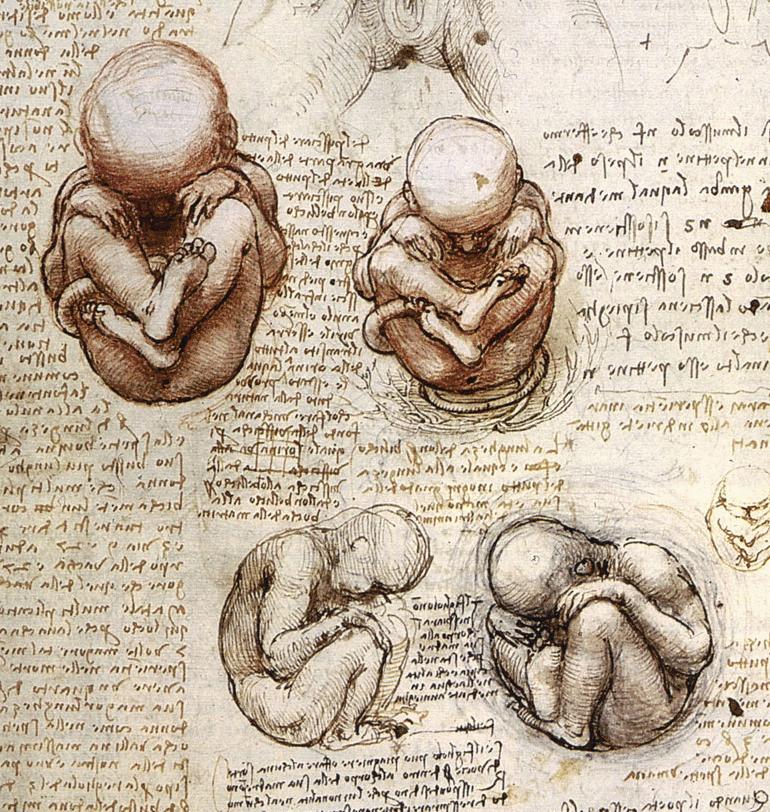
The language baby word beast (and we are beasts even if we would like to seperate ourselves, often on the basis of language itself) is made of that phrase in as many languages are the wordle site can encode. The baby is based on one of my favourite drawings, a fetus seen from a truly unusual angle by a master of many things, not least art and science. The baby is an oblique look at all the arguement that is dormant within our capacity for language.

Hat tip, to Daniel Robert who formed the nucleus of this word beast idea.

(c) Natasha Mhatre
If you're reading this without attribution to me anywhere other than at my blog Talking Pictures, its probably being plagiarized.

URL: http://feedproxy.google.com/~r/blogspot/wcEO/~3/T4Ya0L97P3Y/word-beasts-language-baby.html

Photographing the Wonders of Fall Colors

Photographing the Wonders of Fall Colors

In the northern hemisphere at this time of year there is a great transformation going on with our deciduous trees. Over a 2 week period beginning around the last week of September and then into the first 2 weeks of October the leaves start to loose their green photosynthesis properties and with the inherent nutrients left in the leaves, they come forward in brilliant hues of yellow, orange and red.

As the decay of the leaves continues, these brilliant colours fade to duller browns and yellows, but for a short time it is truly wondrous with the brilliant blanket that covers our landscape.


You would think its easy to go out and capture this kaleidoscope of colors. Simply point somewhere. Press the shutter button and instantly record the scene in front of you. It couldn't be easier. Yet when many people return back home and look at their images on the computer they are rare left wondering where the splendour went. This is really a trick with how the mind records the impressions we see. The mind is really like this perfect DOF instrument that seems to blur not important areas and keeps the key points strong and brilliant. The camera does not work this way.

It's best in many situations to think of the fall landscape as an abstract scene. Therefore, for larger vistas, examine the structure and flow of the patterns within this scene. It definitely is important to use compositional elements of lines and patterns formed by the color patterns to create visual interest within photograph.


With distant trees, use these colourful features to support other elements in the scene such as mountains, rivers or lakes with reflections. To give visual interest for the larger composition.
In many areas there are still lots of evergreens and the fall colors are only interspersed throughout the evergreen canopy. Therefore, you can also isolate specific patches of colour to give a more dominant interest to a patch of color.


Color can also be used to compliment other cooler colours of greens and blues.


At many times it's mainly the yellows that are dominant and any reds and oranges may be hard to find. Do focus on the yellows but provide other visual interests for viewer's attention. People many times will work.


Since the fall foliage is more like an abstract patchwork, don't forget to add in this abstraction with either camera movement or colorful reflections.


Reflections also provide a unique to isolate the complexity by providing context to a water scene.


The key is to get out and first observe and enjoy the splendour of nature. Try and understand what it is about this scene that intrigues you. Then find a solution with the camera that conveys these feelings in the final photograph.


Do forget other venues with fall and its celebratory events of food.

This image reminds me of Mother Goose and her Chicks.


Niels Henriksen

URL: http://feedproxy.google.com/~r/blogspot/kecE/~3/ivngoY7051U/photographing-wonders-of-fall-colors.html