Bissendorf

Bissendorf

Schloss SchelenburgSchloss SchelenburgSchloss SchelenburgSchloss SchelenburgSchloss SchelenburgSchloss Schelenburg
Schloss SchelenburgSchloss SchelenburgSchloss SchelenburgBissendorfBissendorfBissendorf
BissendorfBissendorfBissendorfBissendorfBissendorfBissendorf

bissendorf, a set on Flickr.

If you like castles, check out our weekend trip to Bissendorf, Germany.

URL: http://feedproxy.google.com/~r/rwez/~3/gYDYh6xSCio/bissendorf.html

Deep and inscrutable singular name

Deep and inscrutable singular name

The cats of Old Istanbul are the most practical of all cats. And while you may name them as you please, you will never know their deep inscrutable singular name.

Even the Hagia Sophia's got its own Moggie


URL: http://feedproxy.google.com/~r/blogspot/wcEO/~3/tJmyJzPIvUE/deep-and-inscrutable-singular-name.html

Word beasts 8: Amphibian declines

Word beasts 8: Amphibian declines

detail3
Detail 1
I've written about this before. But I'll quote myself to provide context to the images.

" The Golden toad, a beautiful Costa Rican amphibian, was in trouble according to herpetologist Martha Crump's observations in 1987. We saw the last Golden toad in 1989. In two short years they disappeared.


There were many many reports after that talking about amphibian declines. Large numbers of once common frogs were simply disappearing, entire populations simply wiped out. Rachel Carson's 'Silent Spring' was transposed onto silent streams. Bruce Wilcox noted that between 1996 and 1998 of the 1874 backboned animals added to the Red List of Threatened Species, 1646 (89%) were amphibians! The statistics compiled in AmphibiaWeb also sound quite grim and this is not a resolved crisis. The causes for this decline are perhaps as complex and multiple as they were for the deformities. A large part of the decline is now believed to be explained by an epidemic of fungus. A fungus that is helped along by global warming."


Stare frog flat3 small
Complete image

The fungus that I spoke of  belonged to a group of fungi called the chytrids, Batrachochytrium dendrobatidis. Its been a cause of great concern to the amphibian community. There have been a few reports of treatments that may control it particularly one with topical Chloramphenicol, a common broad-spectrum antimicrobial, often present in simple topical OTC compounds.
While I think this is good, I wonder whether these are scalable solutions. One can hardly pour barrels of chloramphenicol into streams and ponds. You're then left with dealing with capturing and treating animals individually which is well impractical when one thinks of the pandemic scale of the current problem. And even if deal with this pathogen, another might emerge. And we have little in place to control it.
We're doing a lot to this planet that is new and the responsibility for what happens is ours, whether we think so or not, whether we want it or not. They're watching what we do, they're holdings us responsible.


detail2
Detail 2

URL: http://feedproxy.google.com/~r/blogspot/wcEO/~3/jnjoAzrgxOM/word-beasts-8-amphibian-declines.html

Plenty and poverty: Word beasts 7

Plenty and poverty: Word beasts 7

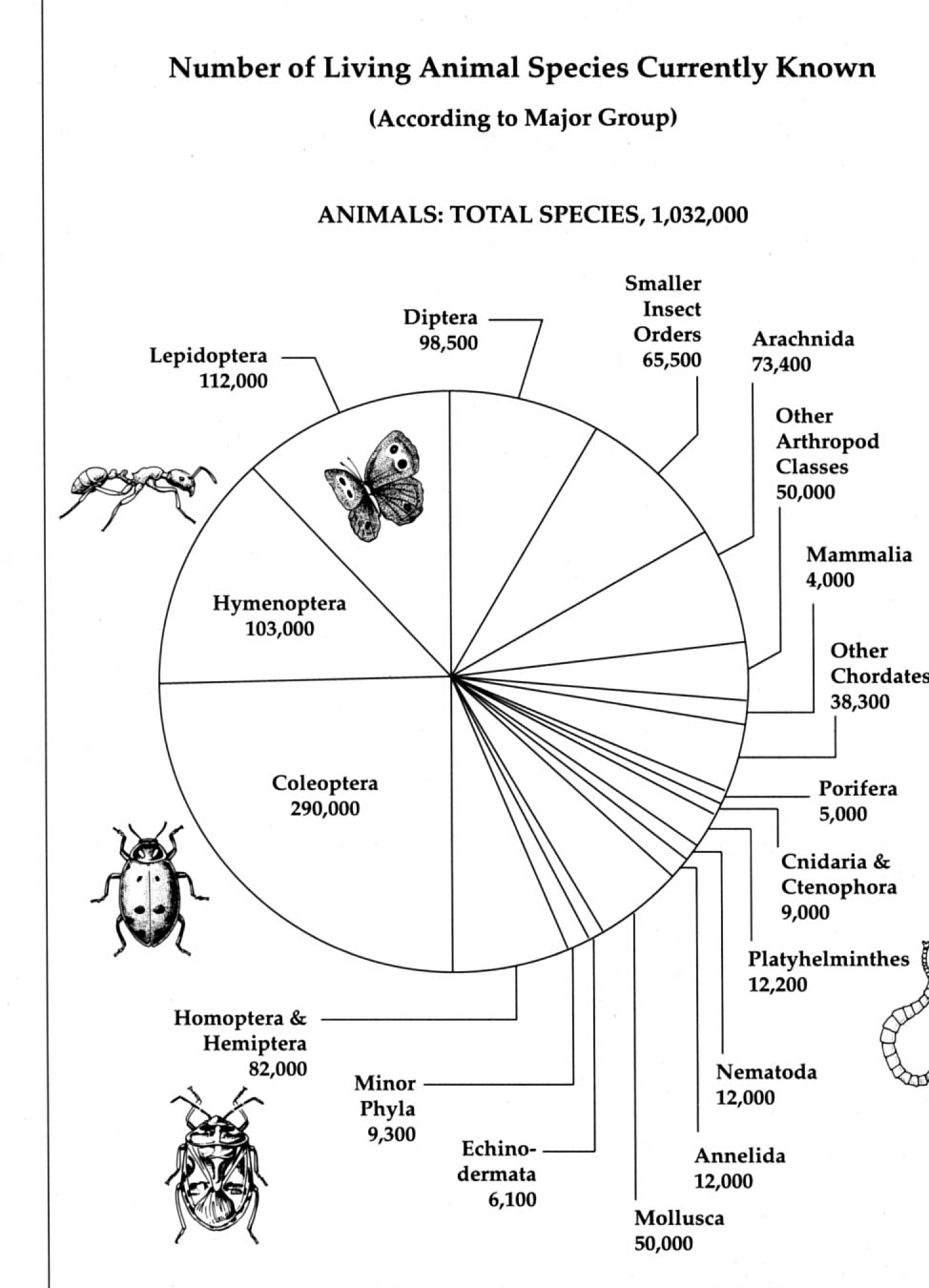
One thing about insects most people will not find surprising and will readily accept is that there are a lot of them. A lot. There's a lot of species too, here is a good, if old, picture of how many more insects there are than other animals. The trouble is that people also think that there are far too many, and think that none of them are charismatic.
That's a very incomplete view of insects, hopefully alleviated somewhat by such awesome documentaries as Life in the Undergrowth and champions of insect life as Dr. Mark Moffett, E. O. Wilson, etc. Insects need their champions pretty bad. And strangely enough they need academic champions as well.
The vast diversity of insects is not matched or reflected in the number of people working on them. Less so by the number of people working in insect taxonomy, the science and art of classifying insect species and studying their relationships. There are, off course, many reasons for this. Pure taxonomy in itself doesn't attract as many researchers anymore; its poorly funded, publishing is difficult and if you are in the 'developing' world where most of the insects are, collections are often out of your reach in the elusive and expensive developed world. On top of this insects, simply aren't attractive enough to people, even to biologists.
They aren't as warm and cuddly as mammals, or as bright and vibrant as birds. (Unsurprisingly the insects that attract most people, as reflected by amateur naturalists, are the 'pretty' ones the butterflies.) And there are a lot of them, which makes life rather difficult. Their taxonomic features are often small and difficult to observe without a microscope, sometime without good dissections skills. It's all just a bit hard.
These Dragons are meant to reflect just that aspect of insect biodiversity, its vastness and the fact that it is under-studied.
Dragons flat small copy
Thankfully, there is a silver-lining to this story. Thanks to one of my friends and colleagues in India, Indian dragonflies have escaped this ignominious fate. They are well documented and studied and there is even a lovely field guide. The extra special ice-cream on-a-top bonus is that its freely available online as part of the Lifescapes series!

URL: http://feedproxy.google.com/~r/blogspot/wcEO/~3/CLeM9zW_LdU/plenty-and-poverty-word-beasts-7.html

INDONESIA Landscapes & Culture Published!

INDONESIA Landscapes & Culture Published!

More information about Rick's Photography:
Photography website
Official Portfolio
Rick's Flickr Photostream


INDONESIA
Landscapes & Culture


INDONESIA Landscapes & Culture is a book devoted to Indonesia and its breathtaking landscapes, the warm people, and its rich and diverse culture.
Rick Wezenaar was born in 1968 in Utrecht, The Netherlands. At the early age of 11 he started with photography and has never stopped since.
In 1989 he started making professional photography. One of the things Rick really likes is travelling. Especially Indonesia has caught his photographic eye. Therefore, during a 4 year 'quest', Rick has travelled the countryside, villages and cities of Indonesia, capturing its beauty and culture. A small part of all these photographs taken during those journeys have found their way into this book. We really hope the viewer will enjoy this publication of Rick's stunning and breathtaking photography!

Book information:

INDONESIA Landscapes & Culture
ISBN: 978-0-557-11430-6
Publisher: Lulu
Copyright: (c) 2009 Rick Wezenaar
Language: English
Paperback, 102 pages, 8.5" x 8.5", perfect binding,
white exterior paper, full color exterior ink,
white interior paper, full color interior ink.

This book will be carried by Amazon, Barnes & Noble, Bol, Ingram, Bowker,
Nielsen, and Lightning Source.

Order a copy of this stunning book here !

Rick

URL: http://feedproxy.google.com/~r/rwez/~3/KI4ynvwculw/indonesia-landscapes-culture-published.html